
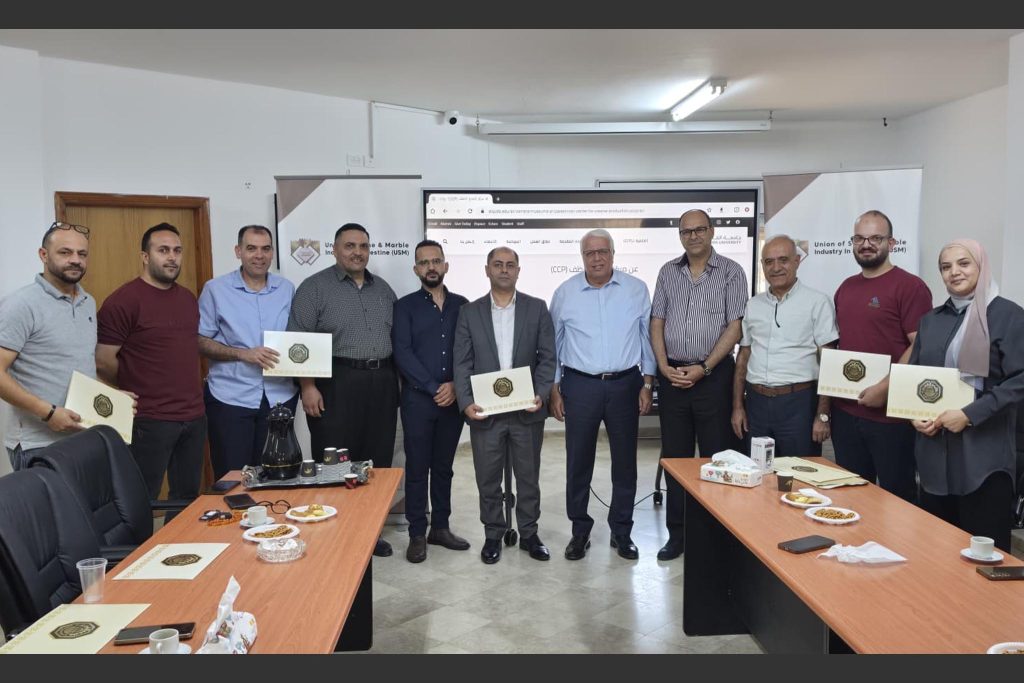
Al-Quds University’s Cleaner Production Center (PCCP) delivered a specialized training program on Resource Efficiency and Cleaner Production (RECP) in collaboration with Eco-Palestine and in partnership with the Union of Stone and Marble in Palestine (USM).
The program aimed to strengthen the capacity of professionals and stakeholders in the Palestinian industrial sector in resource efficiency, cleaner production, environmental management, energy and water conservation, and waste and pollution reduction. These efforts support the transition toward more sustainable and efficient industrial practices.
The 32-hour training program, held over eight days, covered a range of specialized topics, including the circular economy, sustainable consumption and production, the principles of Resource Efficiency and Cleaner Production, and UNIDO’s Transfer of Environmentally Sound Technology (TEST) methodology. It also addressed environmental and energy management systems, material flow cost accounting, life-cycle assessment, and eco-design.
The training placed particular emphasis on the needs of the Palestinian stone and marble sector, addressing the efficient use of energy, water, and materials, as well as waste management, process analysis, and the identification of inefficiencies. Participants also received practical training in measurement tools, data collection and analysis, and the technical and economic assessment of potential improvements.
As part of the program’s practical component, participants conducted a field case study at a stone-processing facility affiliated with the Union of Stone and Marble in the Bethlehem–Hebron region. Working in groups, they carried out a preliminary resource-efficiency assessment, collected on-site data, and identified opportunities for improvement and cleaner production. They then prepared a field assessment report and presented their findings.
The program used specialized training materials in both Arabic and English, along with a range of measuring instruments and field equipment. These included devices for monitoring energy and water consumption, air quality, and dust levels, as well as data collection and analysis templates aligned with the UNIDO TEST methodology.
The program reflects Al-Quds University’s commitment to advancing sustainable industrial development and aligning academic knowledge and practical expertise with the needs of the production sectors. In doing so, it helps improve the efficiency of industrial facilities and strengthens their capacity to adopt environmentally and economically sustainable solutions.
Through its Cleaner Production Center, the university places particular emphasis on developing training programs and technical services in clean technology, resource efficiency, and sustainable industrial practices.
The program concluded with the presentation of certificates to participants who successfully completed the training, awarded by Al-Quds University’s Cleaner Production Center.